Teaching With AI Generated Images
This post is based off MacKay, Connelly, Doyle & Rhind: Teaching Tip Using Artificial Intelligence Generated Media in Veterinary Teaching, under review in Journal of Veterinary Medical Education
We’ve been doing quite a bit of work looking at how generative AI depicts and talks about animals and animal welfare. A lot of it has gone in to a Teaching Tip which we’ve just submitted to JVME. As JVME don’t allow preprints, I’m doing a little preview of it here.
What’s genAI Images then?
As you may, or may not know, a lot of genAI models can now produce very convincing imagery based off of a simple prompt. For example:
Please generate a black and white line drawing in a fairly realistic style of a veterinarian examining a cat. The cat should look stressed and unhappy. The point of this image is to illustrate a slide talking about animal welfare in the clinic environment
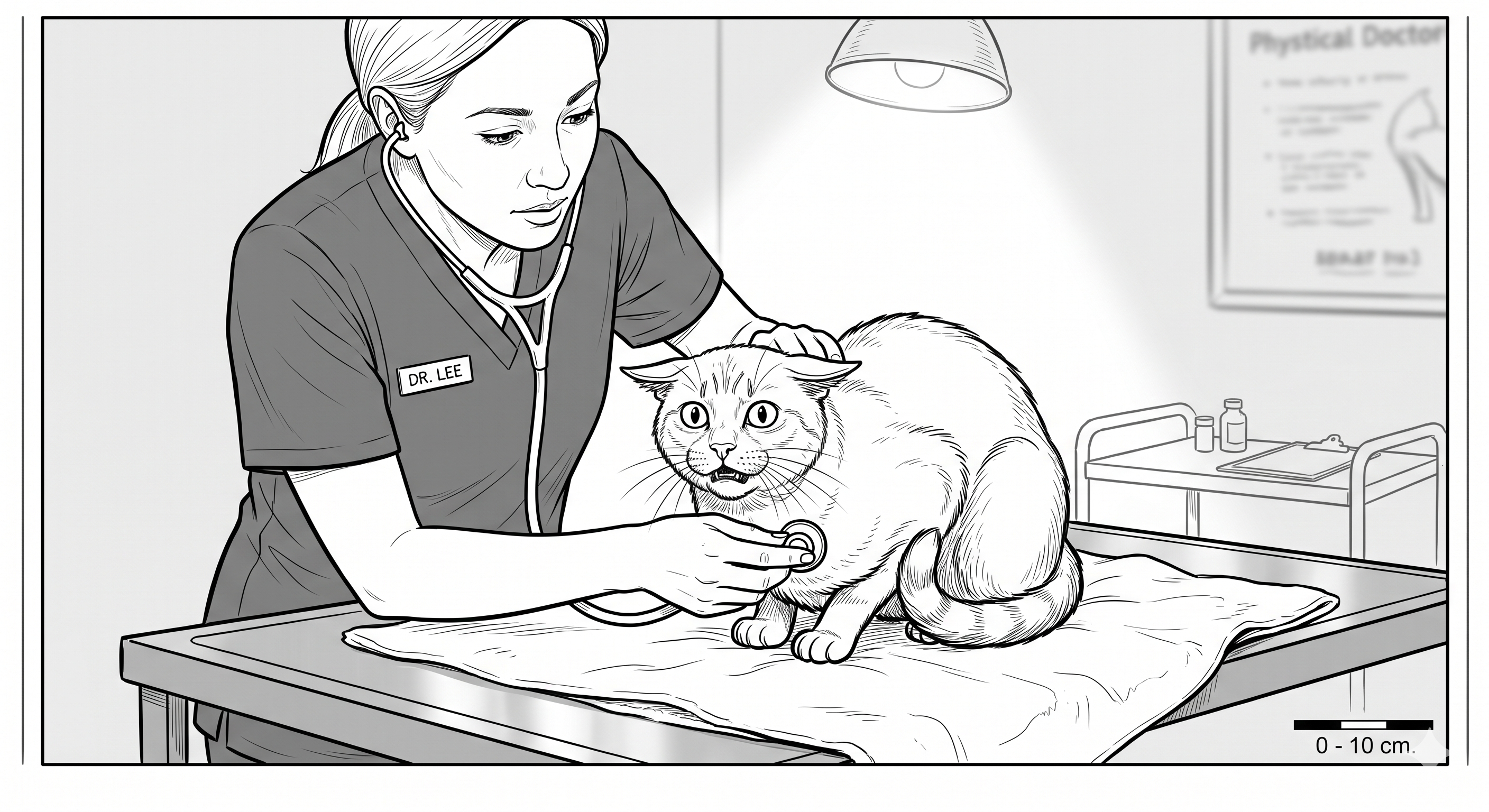
In veterinary science, this is a very exciting prospect. Can we create animal imagery of animals in difficult, uncomfortable, or compromising situations without putting the animal or ourselves at risk?
You’ll be unsurprised to learn that the answer is complicated. Here are our three top tips for using genAI media in teaching.
Tip 1: Use genAI Media Conservatively
Recognising that genAI media is fundamentally coming from a lack of access, it is tempting to utilise it to illustrate many different things. I have, for example, asked for it to create illustrations of my kids so I can share representations of them without sharing their faces (the complexities of this we’ll go into another time.)
But - there is not actually a great deal of convincing evidence showing that media and illustrations are always helpful in teaching. The best evidence suggests that media improves learning most when it is used considerately, conveying specific information, and to be a focus of the teaching.
We should not use genAI media to ‘jazz up’ our slides with meaningless visual information, even though it is fun to play with and it makes your slides look good. Aesthetics are not well linked with learning attainment (even if they do improve learner perception).
Does your gen AI image definitely convey the information it needs to? Is it actually going to support learning? The answer should not be assumed to be ‘yes’!
Tip 3: Recognise limitations and ethical implications
There are a lot of ethical considerations with genAI use, from the environmental cost, to the hidden labour costs, and particularly the stolen intellectual property of the hard working artists who have had their work consumed by these models.
I am deeply concerned with how genAI conceptualises animals and veterinary work. While there are a lot of materials out there to learn from, fundamentally, animals are only represented in the training data from our human lens. Unusual behaviours are over-represented on social media.
Additionally, you need to recognise your own limitations. I don’t work in clinics, can I really judge the clinic environment depicted in the image above? This becomes more obvious when you ask for more technical information conveyed in visual form.
And in visual form …
Of course, we made this inforgraphic with genAI:
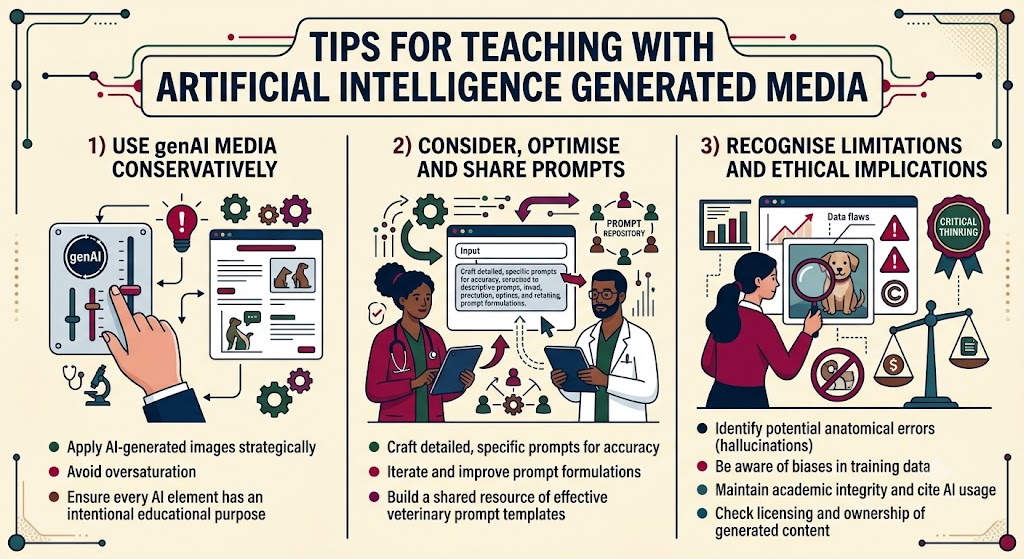
Ok Gemini, we’re about to submit the paper, cross your fingers. Generate me one last image. I want a full colour infographic utilising this colour palette: Background: #FFFBEB Colours: #041E42, #A50034, #154734, #830065, #653024, #325757, #005E70 It should be called: Tips for teaching with Artificial Intelligence Generated Media And your three tips are: : 1) Use genAI media conservatively, 2) Consider, optimise and share prompts, and 3) Recognise limitations and ethical implications. You can choose to design and illustrate it in the way that best maximises impact and accessibility for people, as if used in a slide deck
Further Reasoning
You’ll have to read the whole paper for the full Monty, but here’s a few bits I want to highlight
Using genAI Images Fundamentally Represents a Deficit
Distance learning may not be a deficit, but choosing to use a genAI image fundamentally means you are taking a short cut. You use it because you don’t have access to particular media resource. Either you don’t have access to that kind of situation, you don’t have safe access to that kind of situation, you don’t have access to the artist, or you may not have the time to seek those out. But there’s something you don’t have. Are you the best person to do this?
Does imagery really not help students learn?
First off, just a reminder that the idea of ‘visual learners’ is now widely regarded as a myth
This is a surprisingly under-researched area and most of the time people look at the ‘benefits’ of imagery and aesthetics on student learning they look at student preference. Student experience is important, but its not always a great indicator of student attainment or learning. We do know that slides with lots of competing visual information or non-relevant visual learning harm attainment.
Isn’t it better than using real animals?
There is a growing body of evidence suggesting that genAI does not understand animals or animal welfare, including work coming out from our own Animal Welfare Centre. Watch this space.
Its a flash in the pan
Maybe, but I think we can learn a lot of lessons about how genAI is integrated into our education and outreach. It’s true that some audio-visual generative models, such as OpenAI’s Sora2, have been discontinued very quickly, and it appears to be a difficult place to create revenue, but I think the cat is out of the bag, if you forgive my metaphor, and we need to deal with the use of AI imagery now.
All of the images in this post were created by Google Gemini
You can find a record of the conversation here: link to Gemini’s conversation
My choice of Gemini is not arbitrary. Veo 3.1 and Nanobanana, Google’s video and image generator models have taken steps to embed SynthID in all media generation, which facilitates AI detection. This enhanced layer of identification means it is less likely genAI created media will be mistaken for reality. While it is hard to see on each of the black and white images, all of these images have a visual watermark to indicate they were produced by Gemini and associated models.